Unleash the Pawsibilities!
Relief for Rover at area airports
If man's best friend 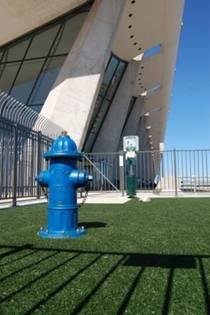 needs a place to go at Washington's three major airports, he now has his own designated areas.
The Metropolitan Washington Airports Authority is debuting "pet relief areas" to provide bathroom breaks for pets and service animals. There are five areas at Dulles, both outside and inside the terminals. The inside locations "feature unique ventilation and flushing/drainage systems" to help keep things clean, according to airports spokesman Rob Yingling. National has four outdoor areas.
The airports are required under federal rules to provide "service animal relief areas," airports officials said.
Baltimore/Washington International Thurgood Marshall Airport already has such an area, according to spokesman Jonathan O. Dean. The area is adjacent to the light rail station at the end of Concourse E on the lower level.
http://voices.washingtonpost.com/dr-gridlock/2010/07/relief_for_rover_at_area_airpo.html
Teri Pifer & Ada
Wanted the team to know I was stopped by an Afghanistan war veteran at Kosair Children's Hospital (Louisville) during my Friday visit. He wanted us to know how much the therapy dogs helped him and fellow troops when they returned and were processing out from the battle zone back to civilian life. He brought tears to my eyes with the sincerity of his acknowledgement of how much the dogs meant to all of them. What a worthwhile cause. Count Ada and Lily and our family in!
Posted at 04:00 AM ET, 08/26/2011
Teacher: How to address bullying school — and how not to
By Valerie Strauss
This was written by Daniel Witz, a classroom teacher and educational consultant in the North Shore suburbs of Chicago. He has been working with middle school students for 25 years and views the school reform movement as highly focused on urban and impoverished schools while failing to spotlight shortcomings in more affluent suburban districts. He can be contacted through his website at danielwitz.com.
By Daniel Witz
PBIS stands for Positive Behavioral Intervention and Support, a disciplinary framework for schools to help prevent bullying that is, in my experience, heavy on jargon but light on substance.
Known by its acronym, PBIS (pronounced "peebis”) has become popular with administrators at thousands of schools across the country desperate to prove they are dealing effectively with bullying.
Kids laugh when I start an announcement that begins “Peebis activities for the week include….” Many simply don’t take it seriously.
But there’s a bigger problem: The pbis.org website markets itself as “one of the foremost advances” with “proactive strategies for defining, teaching, and supporting appropriate student behaviors.” Any time the phrase “proactive strategies” is used in education, I am on the lookout for a whole lot of nothing.
My criticism of PBIS at my school can be distilled into these points:
1) Students view the program as an acronym and some prizes.
2) The data collection and analysis piece is not properly addressed.
3) Lessons for classroom use fail the authenticity test.
The program’s shortcomings are easily understood by examining the implementation of PBIS at my school.
PBIS encourages all schools to create “3-5 behavioral expectations that are positively stated, easy to remember, and significant to the climate.”
The Internet is full of these school-created supports; search “PBIS posters” or “PBIS expectations” to uncover rows of acronyms that signal specific behaviors. There’s SOLE (Self Others Learning Environment) and SOAR (Supporting Others and Acting Responsibly) and ROAR(respect Others Act Responsibly) and many more!
My school chose BAM, which stands for Be respectful, Act with integrity, and Make good choices. I’m fine with our school’s expectations, but in practice it is accepted by sixth graders, somewhat ignored by 7th graders and openly disdained by eighth graders.
The “positive behavioral support” part of PBIS comes into play when a student does something kind or helpful for another student or teacher. That student receives a “BAM” card entered into a weekly drawing for a prize. Teachers will compliment students on being BAM, BAMtastic, or on their general “BAMiness.” Weekly BAM lessons highlight traits such as personal responsibility or treating others with respect.
BAM does not reflect the serious nature of issues students face, nor does it teach students how to cope with the issues.
Proponents of BAM often speak in generalities about its effectiveness because the data collection and analysis component is undeveloped.
My school does not have an electronic data collection system for teachers to use in recording the behavior of students, nor does PBIS offer this type of solution in its implementation. Many schools use “office referrals” for measuring the success of PBIS. Office referrals are easy statistics to generate and are easy statistics to manipulate.
If a principal sets a goal of reducing referrals by 15% through PBIS implementation, he or she is in total control of the data. As we know from standardized testing, schools will cheat if the results make them look better.
Office referrals in most suburban districts rarely measure the climate of the school, or the amount of bullying going on behind the scenes. In schools with generally well-behaved students, most discipline meted out during the day does not reach the point of referral. Those interactions need to be recorded, but overworked teachers are not equipped to stop and enter data for every situation percolating in the halls, classrooms, cafeteria, or locker room.
Bullies understand the system and can get away with multiple negative acts before an office referral occurs. Many student-to-student negative behaviors occur in full view of a teacher and often skirt the line of acceptable. These offenses are the quality of life infractions that can ruin another kid’s day but are not severe enough for a teacher to send a student to the office. Included in this list might be an “inadvertent” jostling in the hall, using a mean (but not crude) nickname that a kid hates, pressuring a kid to share homework answers, or a borderline sexual innuendo.
Here I offer 10 steps to reduce bullying that I believe are broader and more relevant than PBIS to what actually happens among kids. These suggestions derive from my experiences in relatively well off suburban districts and may not relate to all districts.
1) Catalog Behaviors — Create a master list of behaviors that negatively affect the school’s educational climate. The list will be incorporated into a database and must be written with a nuanced understanding of school bullying. For example, “Taking another student’s property” is clearly on the list, but the list also needs to include, “Coercing a student to hand over property.” The kid who repeatedly and aggressively “borrows” lunch money or school supplies from a weaker student without ever intending to pay it back should be in the database.
Major hurdle to implementation: Over-policing student speech
The behavioral focus has to reflect the reality of adolescent thought. Comments like “I hate math class” or “I hate Mrs. Smith” sound negative, but are more about releasing frustration than bringing someone down. Teachers and students need coaching not just in spotting and correcting bullying; they need coaching in how to handle a little rejection. Students should not be entered into the database for saying, “I hate Maggie” or “I hate Devin.” However, starting an “I hate Maggie” club and getting others to “hate on” Maggie clearly crosses the line into harassment.
2) Collect, Access, Analyze, and Report on Data — Once the behaviors are generally agreed upon, the data collection must begin in earnest to identify problems, target remedies, and assess interventions. PBIS should have been developed with a user-friendly application as part of the program. Without an effective interface and database, the evidence is not recorded. Many companies have created these types of applications, but they are cumbersome to use.
Major hurdle to implementation: Available applications are inadequate.
3) Relevant Lessons and Specialized Instruction — Role-playing serious issues must be emphasized in lessons. Students need to be challenged as intensely as they would be in an advanced math class to prepare for the daily range of behaviors exhibited by their classmates and teachers.
Major hurdle to implementation: In my school every teacher serves as an advisor and will lead PBIS lessons regardless of background, desire, or skill set for this type of work. Would a school consider letting any staff member teach advanced algebra? In the wrong hands, even a well-intentioned lesson can muddle a student’s understanding of a concept. Only highly trained staff should be implementing these types of emotional wellness lessons.
4) Personnel Changes — Overhaul the job descriptions of the social workers and the deans. These administrators too often focus on the most visibly delinquent or at-risk students, while missing bullying that exists below the radar. Many students who are deeply troubled by their school experience do not speak up or act up enough to attract notice. There is only one way for a dean or social worker to combat the problems below the surface, and that is to have a working relationship with every single student in the school. School personnel should never forget that the “good kids” have problems too, and they often have information to share, because they believe in justice, fairness, and doing the right thing.
Major hurdle to implementation: The people skills required to establish strong relationships with diverse student populations are rare. I have witnessed too many “limited capacity” social workers who are only effective with “the girls” or “the outcasts” or whatever personality they are drawn to. Social workers must tend to all members of the flock and here I am not referencing race, ethnicity, and religion. I am referring to the artists and the band kids, the geeks and the overachievers, athletes and cheerleaders, skaters and scene kids, the a-listers and the wanna-bes.
Schools need to hire people who can successfully work with the entire spectrum of the student population.
5) Principals must be resourceful and resolute — Many school administrators and teachers are recklessly overconfident in their belief that “talking to” the bully or bringing them into the office will improve the situation. A slap on the wrist shows weakness and can lead to retaliation.
Administrators should solicit the opinion of students on the receiving end to understand their fear, their perspective, and the degree of harassment to see if this approach has potential. In some circumstances, the victims may be ready to stand up in the face of taunts if they knew a responsible adult “had their back.”
Let’s give students some life skills while standing ready to intervene. If a bullied student through coaching finds a way to stand up against the bully or to sidestep the verbal minefields, the victory will permanently elevate a student’s confidence. The situation will have to be closely monitored, as some bullies are more determined than others.
Administrators should always be prepared to bring justice in the form of a suspension or other serious consequence.
Major hurdle to implementation: Egos of school principals who think just “talking to” kids can turn around a bullying situation.
6) Teacher Supervision — Teachers must establish a presence in the hall when students are passing through. This is difficult to enforce as an administrator because teachers may be trying to give extra help to a student or finish a last-minute bit of preparation. The only way to change this culture is through discipline.
School principals should document infractions when a teacher fails to monitor an assigned area. Multiple infractions would lead to a reprimand and ultimately count against performance evaluation. I confess I would initially despise this type of enforcement, but I would eventually get over it, as I believe the hallway presence would be worth the sacrifice.
Without teachers supervising, monitoring, and data collecting, anti-bullying efforts are doomed to fail.
Major hurdle to implementation: Stubborn teachers
7) Personal Space — One major underlying cause of tension in schools is lack of personal space for students. Principals have offices, teachers have planning periods, but students have no place to get away from it all. Kids are crowded together in the halls, at lunch and recess, and even in the bathroom. If there is a way for schools to give kids some breathing space, all the better.
Along these lines, kids frequently singled out for their academic failures are more likely to act up.
Last year I had a student transfer in who was expelled from a private school. In smaller classes at the private school, he was singled out time and time again for his academic failures and ultimately turned that frustration against his classmates. In larger classes in my school he wasn’t singled out as much, and I found that if I kept the spotlight off his weaknesses, he rarely if ever was a behavior problem. If teachers excessively nag students and treat motivation issues as behavioral issues, they really will become behavioral issues.
Major hurdle to implementation: Inflexible school schedules. If I had their schedule and their lack of personal space, I’d lose my mind.
8) School design — School buildings should designed with an eye toward preventing bullying and managing behaviors. Planners and architects have incorporated technology challenges into the physical plant, but how many have been asked to design structures that minimize the potential for negative student exchanges?
Take a simple concept such as locker placement. I realize that space limitations may trump anti-bullying design, but lockers on both sides of a hallway are a recipe for trouble. Unless the hallway is unusually wide, all it takes is one or two students simultaneously visiting on each side to severely constrict traffic flow in the middle. Suddenly, kids are in each other’s personal space. The temptation for the comment, the push, the negative is too great. Hallways with lockers on one side tend to keep traffic moving along the empty wall on the opposite of the lockers.
The problem of bullying or vandalism in the bathroom should also be addressed on a structural level. Bathrooms are not easily monitored but this is the area where some of the worst transgressions take place. The design that I believe works best is when the staff bathroom is placed within the student bathrooms. This design exists in my current school where upon entering the bathroom, there is a locked door to the left that is for teachers only. The design ensures that teachers are continually monitoring the bathrooms out of necessity. There is an added benefit that the students never know when they see a closed door to the teacher’s bathroom whether it is occupied or not.
Major hurdle to implementation: Existing schools are stuck with their current designs.
9) Awareness — Here are three key levels of awareness middle school staff members should possess in order to successfully combat bullying.
a) Pay attention to non-verbal cues. Students reveal their problems more often non-verbally than by directly approaching a teacher. Teachers who understand a student’s typical demeanor can quickly recognize signs when something is amiss. Many instances of hidden bullying can be uncovered this way by listening and observing.
b) Avoid personal power struggles. Adolescents have a strong tendency to classify in black and white categories. This is most visible in social situations as friend/enemy and love/hate can switch in a moment’s notice. This mindset also plays out in discipline. Once a teacher makes “an enemy” of a student, that student will often view everything the teacher represents as not worthy of emulating. Discipline should be handled without a visible personal rejection of the offender. Once a student feels rejected by the adults in a school, the escalation of negative behaviors toward self or others is a given.
c) Identity formation is in flux. With social status at a premium it’s tempting for students in middle or upper grades to adopt an identity that will bestow a certain degree of cool. It takes little effort to become the slacker, partier, or hot girl, yet each one of these designations may bring more status than school-sanctioned identities such as student council representative.
A bully who is selective about his or her targets can generate a following more easily than many honor roll students. The bully frames his identity as “cool” while labeling his victims with some variation of “loser.” Teachers must always be on the lookout for identities based on empty attributes and move those kids toward identities formed with real skill sets and pathways to success.
Major hurdle to implementation: Too many teachers and administrators are only paying attention to grades, homework, and test scores.
10) Stop talking and do something. All of the talk surrounding bullying has reached a crescendo. The point of building consensus and appeasing all stakeholders has long since past. Too many kids hate school, and too many kids are treated poorly at school to discuss the issue any more.
If the teachers don’t want to monitor the hallways between periods, give reprimands, and then replace them with teachers who will. Any school district that does not collect accurate data on school bullying should be called out for failing its students.
Principals need to problem solve each situation independently and fix problems rather than make them worse with pompous grandstanding. They can start by finding better paths for the bully and developing some defense mechanisms for the victims. If that fails administrators should put the hammer down and risk offending some powerful parents by suspending their children. Districts need to fight lawsuits that try to keep schools from separating out the predators from the rest of us. Finally, everybody must collect and analyze data on a daily basis to uncover troublemakers, “hot spots” and patterns.
Major hurdle to implementation: Not everybody will be happy with how it’s done.
The limitations of my ability to reduce bullying can weigh on me at the end of the day. Sometimes I am disheartened by the systems in place, and some days I feel that my 47-year-old body is losing the battle to match the energy of my students. But 25 years of teaching and observing junior high students has given me clarity on how to move forward and make inroads against a seemingly intractable problem.
I don’t expect every student, parent, or educator’s steps to match mine. That’s fine. Make your own list and start acting on it.
Just please don’t bother organizing it into an acronym. By trying to make it “memorable,” your purpose may be forgotten along the way
Below is our story of why we do it:) Enjoy!
Over the last several years, I have been part of a Kentucky Therapy Pet Team. I have two dogs, Bud and Max, both are certified through Pawsibilites Pet Therapy of Kentucky. I would like to tell you a little of what we have seen while doing these visits.
In one of the nursing homes, we visit a Polish woman. The nurses tell us she spends most of her time just lying in bed and has very little interaction with anyone. They were amazed at her reaction to the dogs.
The first time we walked into the room, she got a big smile on her face, she started talking ninety miles an hour, in Polish, and she started looking for treats she could give them. Her breakfast tray was still there, she scooped up scrambled eggs, toast, a package of cheese and crackers, whatever she could. The nurses kept telling her “English, English” she would say a few words, and then go back to her native language. All the while the dogs were thinking, “Hey, we have hit the jackpot.” She showed us a picture hanging on the wall of her father and his dog and began to tell us about them.
We visit an adult day care; most of the clients are younger, probably twenty-five to thirty years old. Usually we sit on the floor in a circle and the dogs go from person to person doing basic commands and collecting treats, lots of treats. Bud is a big dog with an even bigger tail. He usually manages to wag his tail in someone’s face, which is always good for a laugh. One of the clients sits off by himself, usually rocking back and forth, not interacting with anyone. On one of the visits, we noticed he was watching the dogs. When we took the dog over, he stopped rocking, lifted his hand to the dog’s head and for a couple of minutes petted the dog. Everyone said, “Look at Andy!”
Tuesday Bud and I visited an assisted living facility. Usually we stop and talk to the folks who are sitting outside enjoying the nice weather, and then we go inside and walk the hallways, knocking on doors and asking, “Do you like dogs?” Depending upon their answer, we either stay and visit or move on. On this particular visit a gentleman said “Yes, but I don’t want one.” I was getting the feeling we should move on and then he reached down to pet Bud on the head. Bud is a mixed breed, possibly some collie, and it just happened this gentleman had a special fondness for collies. He had lived on a diary farm and his dog always brought the cattle in for milking time. In addition, his dog always knew when it was time for the school bus and would meet the children at the end of the lane. We visited a bit more and as we were leaving, he reached out, put his hand on my shoulder, and said, “You have brought back a lot of good memories.”
We have also been involved with a reading program at a local school. Children with poor reading skills are hesitant to read to an adult or in class for fear of criticism. But what about a dog? There is nothing threatening about sitting on the floor petting and reading to a dog.
I’m not sure how else to put into words the difference these pets make. For a time they bring back happy memories for so many folks, they put others at ease or give them the confidence needed to try something new. Each visit brings new smiles and stories to tell and, as Jo Alley, another team member says, "We don't have to do anything but show up, the dogs do the rest."
Now imagine putting these dogs into the hands of someone who has training in a particular " therapy field". The dogs are the icebreakers, they are non-threatening, they may be the “edge” the physical therapists need to put the clients on the road to recovery. Jo and I both believe an Animal Assisted Therapy Program would be an amazing addition to any therapy team curriculum.
Sandy Heath
Jo Alley
New laws on flying with your service dogs
2011
Service animals can perform a wide variety of functions, some of them not so obvious to airline personnel, who are charged with differentiating between pet-toting fliers shirking the rules and travelers with legitimate medical needs for assistance animals. Airlines must allow service animals to fly in the cabin unless there's a compelling safety reason to bar them.
Vetting emotional-support animals can be delicate, and the DOT emphasizes that employee training is paramount. Airline agents are allowed to question passengers to obtain "credible verbal assurance" that they're traveling with a service animal, not the family pet. They're supposed to ask questions such as "how does this animal assist you with your disability?" and not "what is your disability?" which is considered intrusive. Certainly a statement like "you don't look disabled to me" is inappropriate.
When it comes to paperwork, the DOT makes a distinction between service animals, for example seeing-eye dogs, and emotional-support animals. Airlines are allowed to require documentation for emotional-support animals; with service animals, the DOT encourages air carriers to ask for paperwork only if passengers' verbal assurance is not credible.
Per DOT rules, airlines can ask travelers with emotional-support animals to produce a letter from a mental-health professional certifying that the passenger is under care and that having the animal accompany the passenger is necessary. This letter must be less than one year old and printed on letterhead.
When disputes over service animals arise, airline personnel are supposed to call the conflict resolution official (CRO). Every airline is required to have a CRO available at every airport (or over the phone) during all operating hours. The CRO, sometimes in conjunction with the flight's pilot if there's a safety question, makes the final call.
How can you avoid trouble?
•Notify the airline you're traveling with a service animal so it can advise you on required paperwork.
•Don't rely on the airline's website, as it may not provide details, as in the case of US Airways.
•Know the rules (airconsumer.ost.dot.gov/rules/20030509.pdf).
•Ask for help. Don't argue with gate agents. Have them contact the conflict-resolution official. If the CRO won't let your service animal fly, the airline should provide you a written explanation within 10 days. Travelers can call the disability hotline for immediate help at 800-778-4838 from 7:00 am-5:00 pm Eastern time.
•File a complaint (airconsumer.ost.dot.gov/ACAAcomplaint.htm). Service-animal complaints make up a tiny percentage of overall service complaints.