Trimethylaminuria TMAU
If you have Trimethylaminuria or any other odorous compound emitted by a body odor/halitosis sufferer you are not alone any longer. Your life is only beginning
Pawsibilities Unleashed, Pet Therapy of Kentucky is a 501(c)3 non-profit organization completely run by volunteers and dependent upon donations. They do not use any “train by pain” methods like choke chains or pinch collars. Instead, they use the clicker training method. Their methods are proven in the show ring, at home and for assistance dog skills like seizure detection and diabetic alert.
Pictures and videos provided by Pawsibilities include the following:
- Diabetes Medical Alert Service Dogs works off three different odor levels, and alerts her handler when there is a low sugar level, normal level, and a high sugar level.
- Epilepsy Alert SD alerts child’s family to oncoming seizures up to 30 minutes in advance for some of the larger seizures - Dravet Syndrome
- Medical Alert Service Dog trained to alert to high and low mood swings for Bi-Polar Depression
The same technique, based on odor variances, would work with TMA or any other odorous compound emitted by a body odor/halitosis sufferer. These Service Dogs could be used for the daily benefit of a specific sufferer and/or assisting in diagnostic process, especially in the case of not yet understood odors that modern medicine has not diagnosed.
How clicker dog training Works:
This video shows how a Service Dog is trained with a clicker. Founder, Liz Norris Here’s Liz Norris, Master Trainer and AKC-CGC Instructor, and Therapy Evaluator of Pawsibilities Unleashed working with a 10 month old Weimie. Liz is teaching the dog to go out over an object and touch a target then come back over a jump and target to your hand. The Weimie got this in just an hour of clicker work.
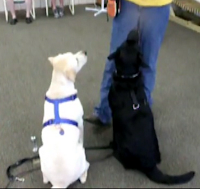
So, what options does a sufferer have to measure his/her odor levels? Apart from purchasing very expensive equipment that would have the capacity to measure only some odorous compounds, which is not practical anyhow, there is also another option - to obtain a Trimethylaminuria Medical Alert Service Dog (SD) trained specifically to give immediate feedback not only about whether a sufferer has odor, but to also indicate if the odor is at a high or low level. The main aim would be to help the person understand their 'smell pattern', Humans acclimate to scent in a room - dogs never doso that perhaps they could alter their diet to suit, to better understand what triggers it, and to plan social activities accordingly.